

Which Option Best Describes Meter
9 Simple vs. Chemical compound Meter
INTRODUCTION
In this unit you will learn simple and chemical compound meters. You volition also begin to sight-read compositions created particularly for this series!
NOTATIONS
Simple vs. Chemical compound Meter Explained
In Unit 2 yous learned to describe meter in terms of how a measure out is broken down into beats. Duple meter is cleaved into two beats per measure; triple meter into three beats per measure; and quadruple meter into four beats per measure out.
The terms introduced in this unit—simple and chemical compound—depict how a beat is broken downward into smaller subdivisions. Simply put, beats are typically subdivided (AKA broken downwards) into twos or threes. Meters that subdivide most of the beats into 2 equal parts are chosen simple meters; meters that subdivide most of the beats into three equal parts are called compound meters. This seemingly small distinction makes huge difference in feel.For me, music in unproblematic meter feels athwart, whereas music in compound meter feels round. Let'due south explore this stardom further.
Both examples below consist of four beats per measure and are therefore in quadruple meter. Withal, the get-go one is in simple quadruple meter and the second is in chemical compound quadruple meter.
Simple Meter Instance
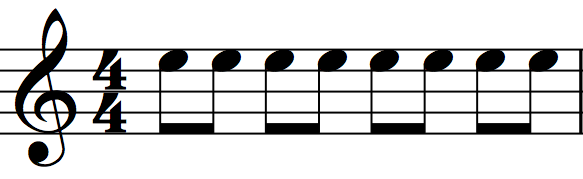
In simple meter well-nigh beats are broken into ii equal parts. Observe how the 8th notes are beamed in groups of two to emphasize the subdivision of the trounce.
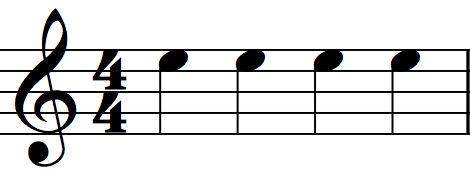
Therefore, in simple meter, each beat is represented by a quarter note.
Compound Meter Example
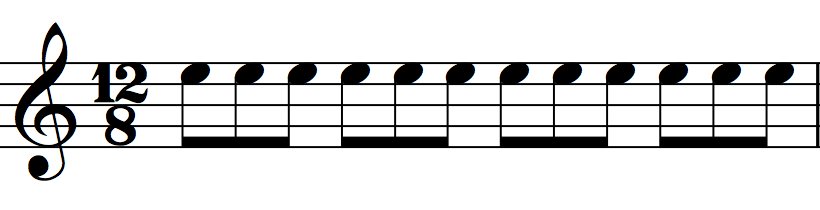
In compound meter virtually beats are broken into three equal parts. Notice how the 8th notes are beamed in groups of 3 to emphasize the subdivision of the beat.
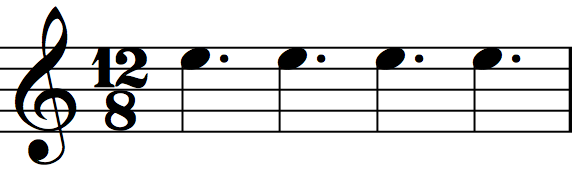
Therefore, in compound meter, each crush is represented by a dotted-quarter annotation.
Six Types of Standard Meter
Similarly, duple and triple meters can be expressed in simple and compound likewise. Thus, there are 6 types of standard meter in Western music:
Simple Duple
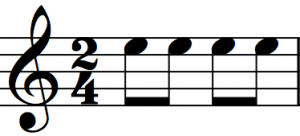
In simple duple meter most beats split up into eighth notes. In that location are 2 beats per measure out and each beat is a quarter note.
Simple Triple
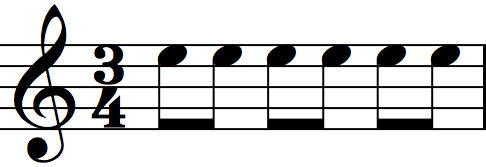
In simple triple meter most beats divide into eighth notes. In that location are 3 beats per mensurate and each beat out is a quarter note.
Simple Quadruple
In simple quadruple meter most beats divide into 8th notes. There are 4 beats per measure out and each beat is a quarter note.
Chemical compound Duple
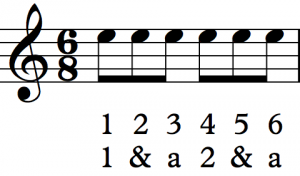
In compound duple meter nearly beats dissever into three eighth notes. In that location are two beats per measure and each shell is equivalent to a dotted-quarter note. This meter can be counted in a variety of ways. The graphic above presents two options. I recommend using the second pick because information technology emphasizes the duple feel.
Chemical compound Triple
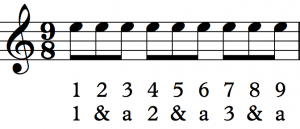
In compound triple meter most beats split into three eighth notes. There are three beats per measure and each shell is equivalent to a dotted-quarter note. This meter tin can be counted in a multifariousness of means. The graphic above presents two options. I recommend using the second option because it emphasizes the triple feel.
Compound Quadruple
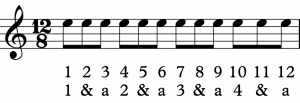
In compound quadruple meter most beats dissever into three eighth notes. There are four beats per measure and each beat is equivalent to a dotted-quarter note. This meter can exist counted in a variety of ways. The graphic higher up presents two options. I recommend using the second selection because information technology emphasizes the quadruple feel.
The Hemiola
The hemiola is a device in which rhythmic accents switch from two beats subdivided in three parts to three beats subdivided in two parts (or vice versa). It creates excitement and free energy. I advise you emphasize the change in emphasis whenever you lot encounter a hemiola.
The Hemiola in Chemical compound Meter
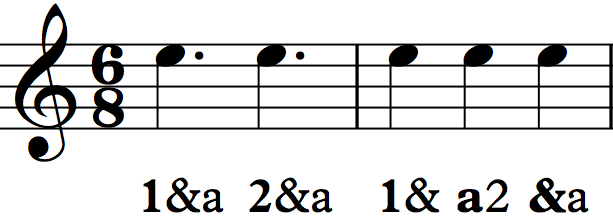
When a hemiola appears in compound meter the rhythmic accents switch from 2 beats subdivided in three parts to three beats subdivided in ii parts.
The Hemiola in Simple Meter
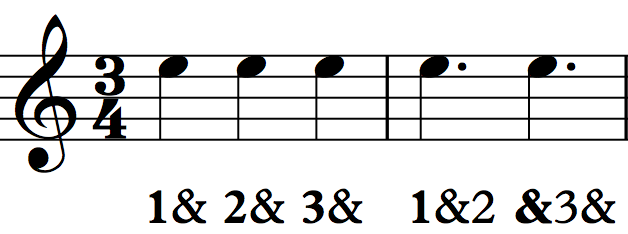
When a hemiola appears in unproblematic meter the rhythmic accents switch from three beats subdivided in 2 parts to two beats subdivided in three parts.
Simple vs. Compound Meter Time Signatures
Superlative Number of the Time Signature
To determine meter, you can use the following brusk cutting. Wait to the top number of the fourth dimension signature.
| Simple duple | 2 |
| Uncomplicated triple | 3 |
| Simple quadruple | iv |
| Compound duple | vi |
| Compound triple | 9 |
| Compound quadruple | 12 |
Lesser Number of the Time Signature
Elementary Meter
As you learned in Unit 2, the bottom number of the time signature, in elementary meter, corresponds to the type of note that becomes a single beat (AKA pulse, in this case). Therefore, if the bottom number is '4,' then each beat is represented by a quarter annotation. Information technology's pretty elementary, which is why information technology is called uncomplicated meter.
Compound Meter
In compound meter, the bottom number of the fourth dimension signature corresponds to the blazon of note that becomes a i-third partitioning of the beat (AKA pulse, in this case). If compound meter is notated such that the dotted-quarter annotation is the trounce (every bit in the examples to a higher place) so the eighth note is the i-3rd division of the dotted-quarter. Hence, the number 'eight' takes the place of the lesser number of the time signature.
 | Let's Play |
Sight-Reading Tip
Sight-reading empowers you to appoint with music you may have never heard earlier. Many musicians derive oodles of joy from bringing music notation to life for the first hearing. It is similar unwrapping a present! Further, sight-reading creates an opportunity to determine whether a slice is worth investing the time needed to make it performance-prepare.
When I started sight-reading for the purpose of scouting new performance repertoire, I finally stopped confusing the deed of sight-reading with the act of performing. When I sight-read, my goal is to get a sense of the shape, character and difficulties of a piece. Sometimes, mistakes do not go far the style of achieving that goal, which is why they tin can exist ignored. However, when I prepare for operation, my goal is to master the shape, character and difficulties of a piece. In this case, mistakes are crucial to goal attainment. Mistakes are obstacles that, when overcome, clear the path to greater mastery.
I want y'all to experience the difference between a sight-reading attitude and a performance-preparation attitude. This was one of my motivations for commissioning composers to write over thirty original duet compositions for this series. You exercise not have to perfect these compositions. All you have to do is sight-read them. If you don't like the piece, feel free to continue through the serial without mastering it. Nevertheless, if you do similar i or more of the compositions, I encourage you to shift from a sight-reading mental attitude to a performance-preparation attitude then you can add together them to your performance repertoire. The original compositions are available in the Appendix as a collection entitledThe Obelisks.
Checklist for Sight-Reading
- Count the beats out loud (including the&).
- Keep going (fifty-fifty if you brand a mistake).
- Maintain your best playing posture.
- Await at the score, not your hands.
- Play with the feel of the meter.
- Play patterns instead of individual notes (AKA clamper).
- Cultivate a calm demeanor.
- Have fun!
| | Permit'south Play Rhythms |
Attitude Tip
The most beautiful affair we tin experience is the mysterious. It is the source of all true art and science. –Albert Einstein
Throughout this unit the count-in click for pieces in chemical compound meter will include the eighth note subdivision of each beat. An accent volition exist placed on the start of each beat to aid establish the compound meterexperience .
Exercise nine.1: Score
Exercise nine.ane: Audio
Exercise 9.2: Score
Exercise 9.2: Audio
Exercise ix.3: Score
Practise ix.3: Audio
| | Permit'south Play Patterns |
Attitude Tip
I have no special talents, I am only passionately curious. –Albert Einstein
Do 9.4: Score
Do 9.four: Sound
| | Let'due south Play Duets |
Attitude Tip
The cure for colorlessness is curiosity. In that location is no cure for marvel.–Dorothy Parker
from Sumer is Icumen In: Score
from Sumer is Icumen In: Audio
from Have a Potable on Me: Score
from Have a Beverage on Me: Audio
Gigue from Partita in A Pocket-sized by Johann Anton Logy: Score
Gigue: Audio
The Obelisks
The compositions equanimous for this series are complied into a drove chosen The Obelisks. The drove is bachelor for viewing and downloading in the Appendix (forthcoming). I hope you are inspired to perform these pieces and learn nearly the composers who contributed to this series.
| | Allow's Play Compositions |
These compositions are under the Creative CommonsAttribution-NonCommercial iv.0 International License (CC By-NC 4.0).
Mental attitude Tip
Curiosity is the engine of achievement. –Sir Ken Robinson
The First Time Lone by John Baboukis: Score
The First Time Alone: Audio
Earlier, No. 1 from Cursory Moments past Mark Popeney: Score
Before, No. 1 from Brief Moments: Sound
Congratulations!
You accept completed this unit of measurement! If yous kept upwards with the trounce and accurately played approximately 70% of the pitches and rhythms, you are ready for the side by side unit. Experience free to repeat the exercises. However, do not play them so often that you memorize them. Once y'all memorize the annotation, you are no longer developing the skill of sight-reading.

Which Option Best Describes Meter,
Source: https://press.rebus.community/sightreadingforguitar/chapter/unit-9-simple-vs-compound-meter/
Posted by: petersenpectiong.blogspot.com
0 Response to "Which Option Best Describes Meter"
Post a Comment